
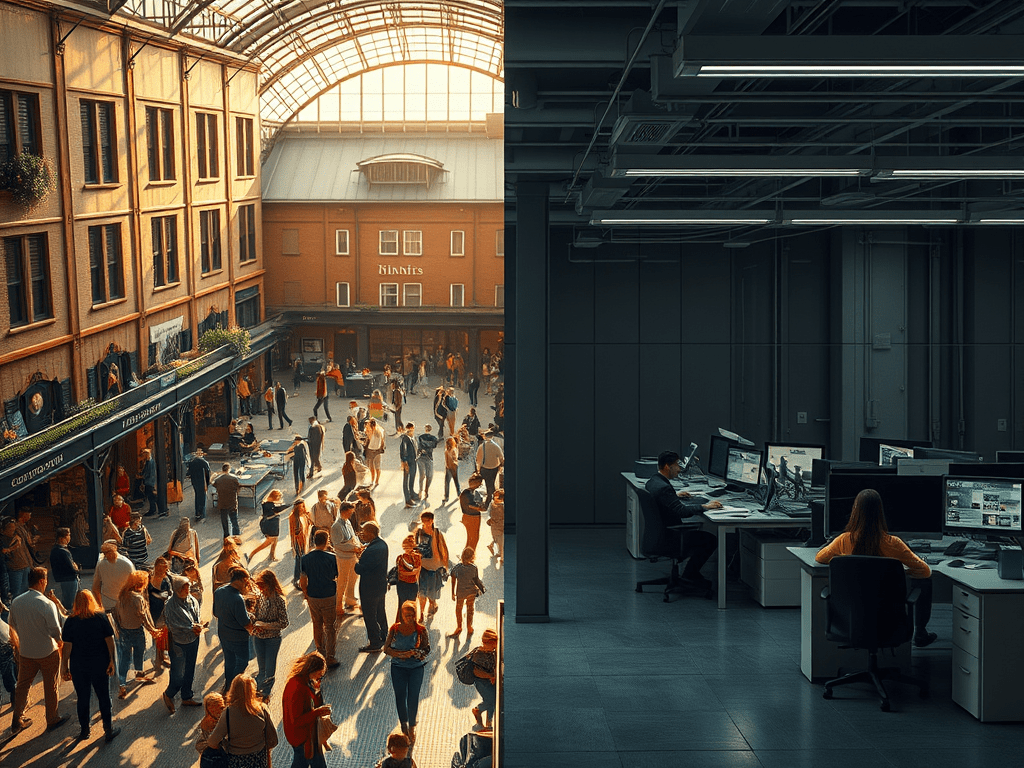
In our modern society, we are told that progress means bigger homes, better technology, and endless economic growth. Yet, a closer look at history reveals a darker truth: as we’ve privatized our common spaces and devoted our lives to work, our communities have frayed and our human connections have withered. This isn’t just an abstract notion—it’s a lived reality, one that became painfully clear during the COVID-19 pandemic and continues to shape our daily lives.
The Death of the Commons
For centuries, community life was built around shared spaces—the commons—where neighbors gathered, exchanged ideas, and supported one another. As society shifted its focus toward individual prosperity, these communal areas gave way to privately owned spaces. We now boast larger, more comfortable homes, but at the cost of losing the public spaces that once bonded us together. The result is an environment where our social interactions are increasingly confined to digital screens or isolated within our homes.
The Industrial Revolution: A Double-Edged Sword
Each industrial revolution promised technological and economic breakthroughs. Yet, with these advancements came a steep price: the erosion of time spent with family and community. As work moved from home-based production to centralized factories—and later, to sprawling office complexes—the demands of the workplace began to dominate our lives. Long hours, relentless work schedules, and the glorification of productivity have all contributed to a society where our most valuable resource—time—is increasingly monopolized by our jobs.
COVID-19: A Wake-Up Call
The COVID-19 pandemic forced many of us to confront what we had sacrificed in the name of progress. Lockdowns and social distancing stripped away the veneer of our material abundance, revealing the profound emptiness of our overworked lives. Work, once again, emerged as a formidable barrier between us and our loved ones, leaving many exhausted and isolated despite the promise of modern convenience.
Government Policies: Pushing Work Over Family
In Australia, recent government policies have compounded this problem. Increased funding for childcare—ostensibly aimed at enabling parents to return to work—has instead contributed to a reality where more time is spent in the workplace and less with family. While lower childcare costs help families earn enough to meet the skyrocketing expenses of housing and food, they do nothing to reduce those very costs. In fact, the high cost of living forces many to work full time, perpetuating the cycle of exhaustion and isolation.
A Call for Change: Reclaiming Our Communities and Economic Balance
It’s time for a radical rethinking of what progress means. We must challenge a system that forces us to work relentlessly just to afford our homes and food—a system where even the promise of affordable childcare is used to keep us tethered to the workforce. The call for change must include:
- Economic Reform:
We need policies that don’t just subsidize work but actually reduce the cost of living. Imagine a society where housing and food are affordable enough that work isn’t our sole means of survival—where economic stability isn’t measured solely in wages, but in quality of life. - Revitalizing the Commons:
Investing in public spaces—parks, community centers, and shared facilities—that foster social interaction and community spirit is essential. By reclaiming the commons, we create opportunities for connection outside the confines of our isolated homes. - Rethinking Work-Life Balance:
Policies should focus on reducing the work burden. This might mean shorter workweeks, more flexible schedules, or even a redefinition of success that values family time, creativity, and community well-being over endless productivity. - Family-Centric Priorities:
While affordable childcare is crucial, it shouldn’t come at the cost of reducing family time. We must craft policies that enable parents to thrive both at work and at home, without being forced into a cycle of perpetual labor.
Our current reality—a materialist dystopia where work overshadows life and communities crumble under economic pressure—is not inevitable. We have the power to redefine progress, to design a future where social bonds and well-being are valued as much as economic output. It’s time to elect leaders who recognize that our greatness as a society isn’t measured by the size of our bank accounts, but by the strength of our communities and the quality of our lives.
Conclusion
The story of our modern society is one of remarkable technological and economic achievements—but it is also one of growing isolation and community decay. We live in a materialist dystopia where work, privatization, and misguided policies have stolen the time and space we once shared with each other. The time has come to challenge this narrative and reassert that true progress is measured not by relentless economic growth but by the health of our communities and the well-being of our people.
Let’s reclaim our future by demanding economic reforms that reduce the cost of living, revitalizing our commons, and creating policies that balance work with family and community. Only by doing so can we break free from the cycle of endless work and rediscover the true meaning of progress.
 BIRDnews
Leave a comment